The question most often asked by aspiring date resellers before buying wholesale is simple yet crucial: "How many kilograms are in one carton, and if I resell it, what is my profit?" Without answering these two things precisely, you trade by guesswork. This article provides a reference for date contents and weight per box across varieties, then walks you through calculating cost of goods and margin in a structured way — complete with real examples.
How Much Is in One Date Box? Understanding Packaging Variation
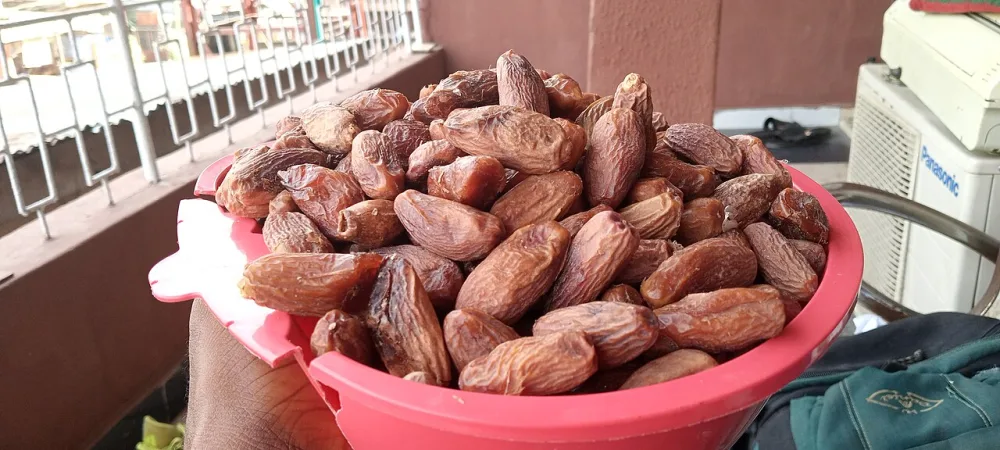
There is no single standard for "the contents of one date box". Based on marketplace and wholesale listings, carton sizes vary widely by variety, producer, and product class. Real examples from market listings: Sukari dates appear in 3 kg boxes, also 9 kg and even 17 kg configurations, plus boxes of 12 packs of 500 grams (6 kg total); Egyptian dates are usually sold per 10 kg box; jumbo Medjool is often packed per 5 kg box. So always confirm the net weight per box, not merely "one box", before comparing prices.
| Variety | Common Carton Configuration | Key Note |
|---|---|---|
| Egyptian dates (Golden Valley, Barari) | 10 kg box | Iftar workhorse; market price ~Rp290k-350k/10 kg box |
| Sukari dates | 3 kg / 9 kg / 17 kg / 12x500 g box | Many variations; check net weight carefully |
| Jumbo Medjool | 5 kg box | Premium; market price ~Rp1.1m-1.2m/5 kg box |
| Khalas dates | 10 kg pack | Wide market price range by grade |
| Tunisian stem-on dates | 5 kg / 10 kg carton | Stem-on for gifting |
The price figures above are market ranges cited from 2026 marketplace listings and can change, especially spiking before Ramadan. Use them as a guide, not a quote.
How Many Dates per Kilogram?
Beyond weight, resellers who sell by the piece or make hampers need an estimate of pieces per kilogram. This depends on date size (grade): the larger the piece, the fewer per kg. As a general picture, large dates like jumbo Medjool number fewer per kg than small dates such as some Egyptian types. Because grading varies between suppliers, the most accurate method is to weigh and count a sample from the batch you receive, then use it as a benchmark for hamper portions or retail packs.
A Framework for Calculating Cost per Kilogram
Your cost of goods is not merely the purchase price per box. For resellers, the true cost per kg is:
Cost per kg = (Box purchase price + shipping + repacking cost + shrinkage) ÷ net weight per box
Many resellers forget the last three components, then wonder why their margin is thin. Let us break it down:
- Shipping cost: if stock ships inter-city, road cargo rates are often per kg with a minimum. As a market picture, road cargo from Jakarta can run around Rp2,500/kg with a 50 kg minimum, and to Greater Jakarta satellite cities such as Bogor, Depok, Tangerang, Bekasi around Rp3,500/kg (2026 courier ranges). If you collect directly from the warehouse, this component can be reduced.
- Repacking cost: if you split a 10 kg box into 500 gram or 1 kg packs, count the pouch, sticker, and labour costs.
- Shrinkage: set aside a small percentage for dates that are damaged, dried, or unsellable.
A Real Worked Example
Suppose you buy one 10 kg box of Egyptian dates for Rp320,000, collected directly from the warehouse (no shipping), then repack into 1 kg packs for retail. Assume packaging cost of Rp2,000 per pack and 3% shrinkage.
| Component | Value |
|---|---|
| Purchase price per 10 kg box | Rp320,000 |
| Sellable weight after 3% shrinkage | ~9.7 kg |
| Packaging cost (10 packs @Rp2,000) | Rp20,000 |
| Total capital | Rp340,000 |
| Cost per sellable kg | ~Rp35,050/kg |
| Retail selling price (example) | Rp45,000/kg |
| Gross margin per kg | ~Rp9,950/kg |
| Estimated gross profit per box | ~Rp96,500 |
These figures are an educational illustration, not a guarantee. The point: with this framework you know exactly the profit per box before buying, so you can set a healthy selling price and decide how many boxes make sense to take.
A Capital Calculator: Step by Step
Build a simple calculator (a spreadsheet suffices) in this order for each variety:
- 1. Record the box purchase price and its net weight.
- 2. Add shipping cost per box (if any).
- 3. Add repacking cost if you split packaging.
- 4. Reduce weight by the shrinkage percentage to get sellable weight.
- 5. Divide total capital by sellable weight = cost per kg.
- 6. Set the selling price, compute margin per kg and profit per box.
- 7. Multiply by the target number of boxes for total profit projection.
With this table, you can compare profitability across varieties: sometimes a cheap date has a small rupiah margin but sells fast (high volume), while a premium date has a large rupiah margin but turns over more slowly. Both can be profitable depending on your market.
Setting a Reasonable Selling Price
Some pricing principles for date resellers:
- Understand the local market price so you are not too expensive (hard to sell) or too cheap (eroding margin and the market).
- Distinguish retail and wholesale prices if you also serve sub-resellers; provide a price ladder by volume.
- Use seasonal momentum: demand and prices rise sharply before Ramadan (February 2024 imports up 51.28% over January per BPS), when margins can be healthier — but prepare stock early.
- Do not forget other operating costs (daily transport, marketplace platform, promotion) when computing net profit.
Tips to Buy with Efficient Capital
- Start with fast-moving varieties in a volume matching your selling speed, then add premium varieties.
- Collect directly from the warehouse where possible to reduce shipping, or combine orders to meet the cargo minimum.
- Always compare prices on a per-net-kg basis, not per "box", because box contents differ.
- Raise volume gradually with your sales record to earn a better wholesale price ladder.
To help, kurmagrosir.co.id offers a range of varieties in packaging options from cartons to large volumes, so you can match your purchase size to your capital math and your shop's selling speed.
Conclusion
Knowing the contents and weight of dates per box, then calculating cost of goods and margin in a structured way, is the foundation of profitable date trading. Never compare prices on "one box" alone — always reduce to a per-net-kg price after including shipping, packaging, and shrinkage. With a simple calculator and the worked example above, you can determine which variety is most profitable, how many boxes make sense to take, and a healthy selling price — so every carton you buy truly produces a measurable profit, not just hope.